
Compared to conventional steering, 2D steering represents a significant evolution in paraglider control, offering a broader control range and more options. It will particularly appeal to pilots who prefer playful maneuvering close to the ground, alongside highly precise lift generation and flare during take-off and landing.
In principle, the 2D system allows you to alter the steering geometry. By pulling down (the "y" axis) while simultaneously varying the distance of the brake handles from the risers (the "x" axis), you selectively engage the central and outer parts of the canopy's trailing edge.
Initially, 2D steering requires practice and building specific habits. Good news for your first introduction to 2D steering! With a conventional hand position (i.e., handles approximately 20 cm from the pilot's shoulders on the "x" axis) and subsequent downward pull on the "y" axis, 2D steering operates almost identically to conventional steering, making adaptation very easy.
Note: Before using the 2D system extensively in demanding conditions, spend time practicing on the ground and in smooth air to refine your individual control technique.
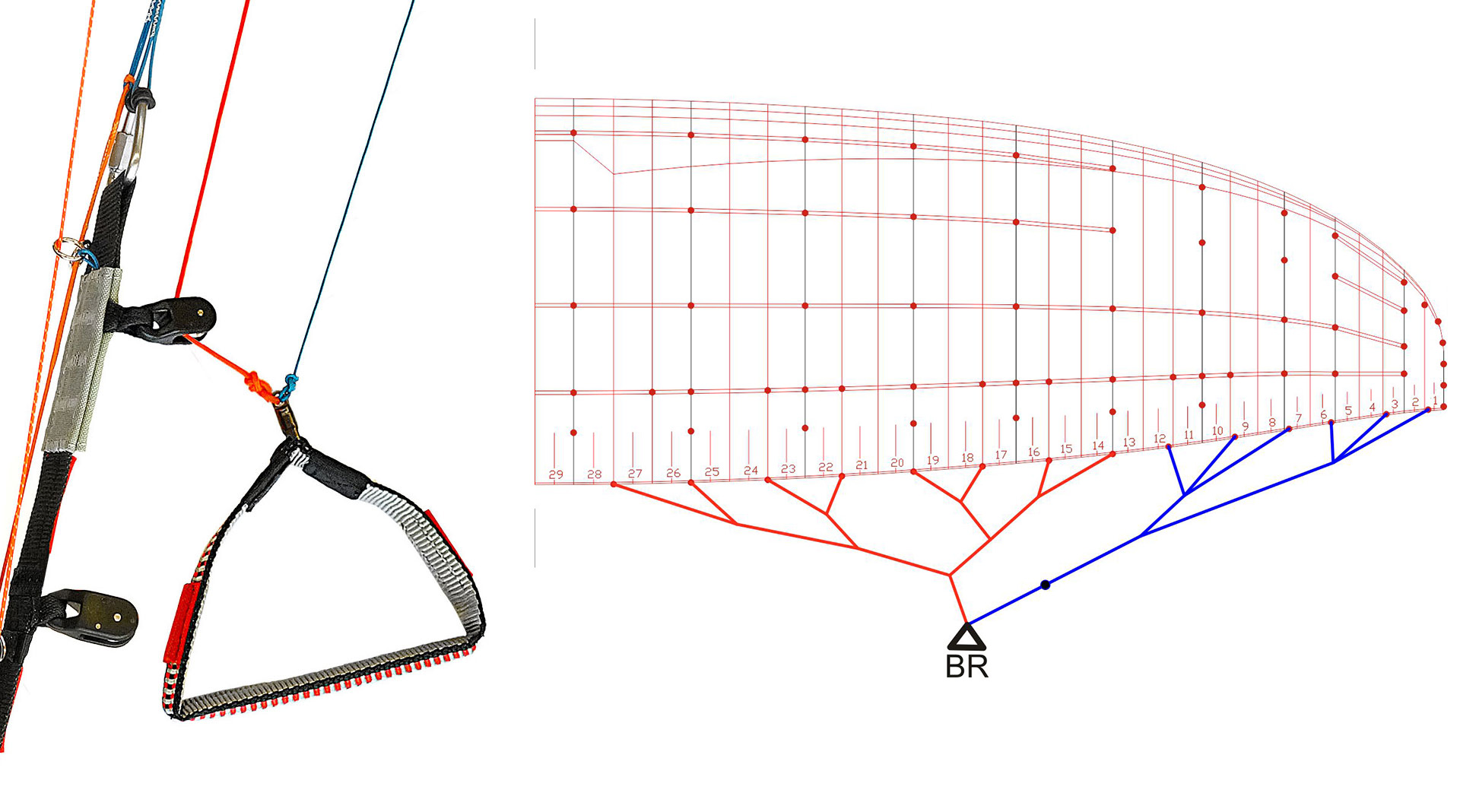
The 2D system responds to both the amount of travel (brake input depth) and the lateral position of your hand. The main brake line runs through a pulley on the D-riser and connects to the brake handle, while the outer brake line connects freely directly to the handle. (See image and diagram below)
By dynamically shifting your hand position, you can effortlessly combine these two inputs to control bank angle, sink rate, lift, and overall steering geometry.
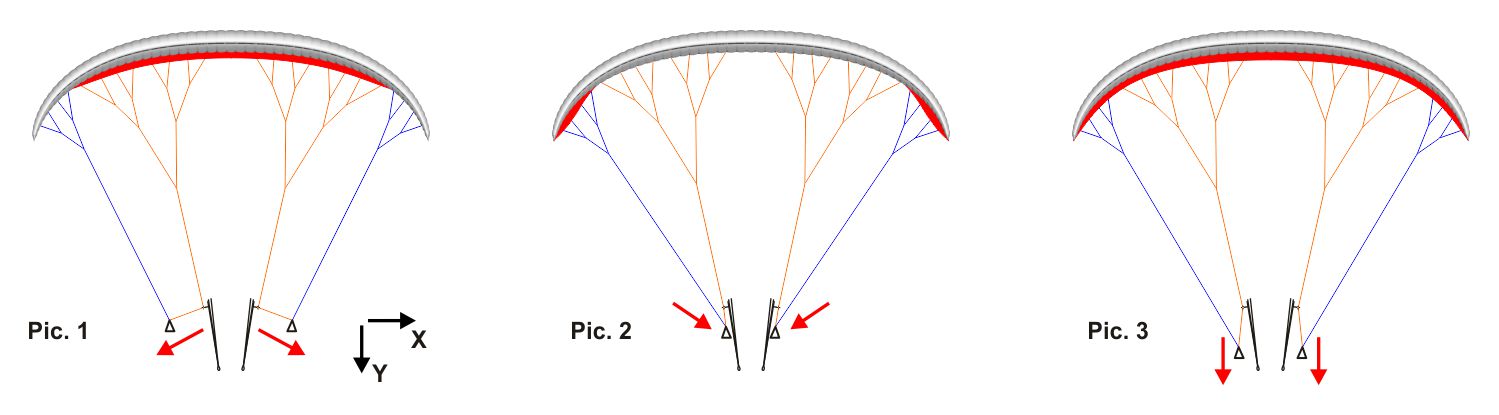
The factory setting of the brake lines offers a balanced compromise tailored to the wing and differs significantly from competitor‘s 2D steering. The level of lift generated during turns when activating the outer trailing edge allows for comfortable handling while maintaining a safe margin against stall. If you are accustomed to 2D steering from an other glider, adaptation will require some time.
The lengths of both brake lines are set for standard paramotors with mid to low hang-point systems. However, the system is designed to be fully adjustable to your specific needs.
For high hang-point paramotors, the main brake lines can be routed through both pulleys on the D-riser. Caution! In this case, both the main and outer brake line settings must be lengthened by 15 cm.
Personal Preference Settings: The ratio between the main brake lines and the outer brake lines can be adjusted to suit your paramotor and your flying style. The maximum length adjustment is 5 cm.
Critical Safety Check: Ensure the brake lines are long enough so that the canopy's trailing edge is not engaged (pulled down) when flying at maximum speed (trimmers fully open and full speedbar applied).
Warning: To maintain wing stability, it is essential to use only the outer part of the system when flying at higher speeds. Engaging the main (inner) brakes at full speed significantly increases the risk of a collapse.